
Over the past year, the Middle East has entered a phase of high-density structural instability, defined less by a single dominant crisis than by the systemic overlap of multiple political, military, and strategic dossiers that mutually reinforce one another. Traditional fault lines – interstate conflicts, civil wars, ideological competition, and geopolitical rivalries – are increasingly converging within a highly interdependent regional space, where localized developments generate cascading effects on a broader scale. In this context, the MENA region appears less governed by stable equilibria and more exposed to dynamics of strategic contagion, in which deterrence, controlled escalation, and tactical diplomacy coexist in a precarious balance.
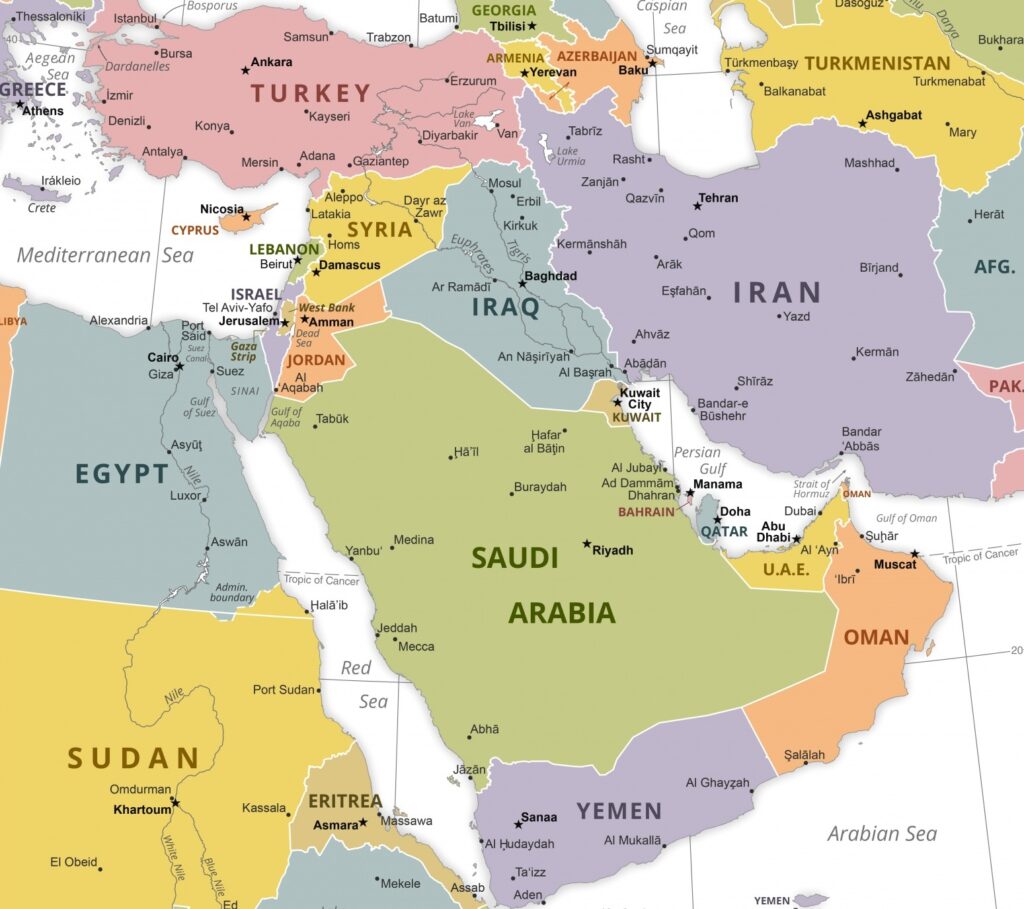
At the center of this critical landscape lies the strategic triangle between the United States, Israel, and Iran, which continues to constitute the backbone of regional security dynamics. Relations between Washington and Tehran are once again oscillating between reinforced deterrence and selective diplomacy. On the one hand, the strengthening of the US military posture in the Persian Gulf and the Levant – accompanied by messages of firmness and signals of ambiguous openness – aims to deter Iran from destabilizing actions or from a unilateral acceleration of its nuclear program. On the other hand, the reactivation – albeit intermittent – of nuclear negotiation channels reflects Washington’s desire to prevent the confrontation from escalating into a direct clash or into an irreversible proliferation dynamic capable of structurally reshaping regional balances. United States decision-making, however, is shaped by a range of factors that render Washington’s strategic line particularly complex and uncertain. These include the presence of a substantial US military deployment in the region, the need to preserve minimal diplomatic channels, pressures exerted by regional allies – often divergent among themselves – the dynamics of domestic public opinion, and Iran’s internal political and social conditions. In particular, the positions adopted by some Arab partners in the Persian Gulf – opposed to military escalation or reluctant to facilitate direct action against Tehran – constitute a key source of friction that constrains US room for maneuver.
Within this framework, Israel plays an ambivalent yet decisive role. Tel Aviv views any renewed diplomatic opening between the United States and Iran with extreme caution, fearing that an agreement limited to the nuclear dossier would merely freeze the problem temporarily while leaving intact Iran’s missile capabilities and, above all, its network of non-state armed actors along Israel’s strategic frontiers. Israeli pressure on Washington should therefore be interpreted less as an attempt to block negotiations outright than as an effort to shape their terms by expanding the security perimeter to include not only nuclear constraints but also limits on Iran’s regional activities. Nevertheless, the political space for a truly “comprehensive” agreement remains extremely limited. The most realistic scenario continues to be a temporary and partial arrangement designed to freeze certain sensitive Iranian activities in exchange for selective sanctions relief, with the aim of buying time and reducing the risk of military escalation. At this stage, negotiations thus function more as a risk-management mechanism than as a structural resolution of the dispute.
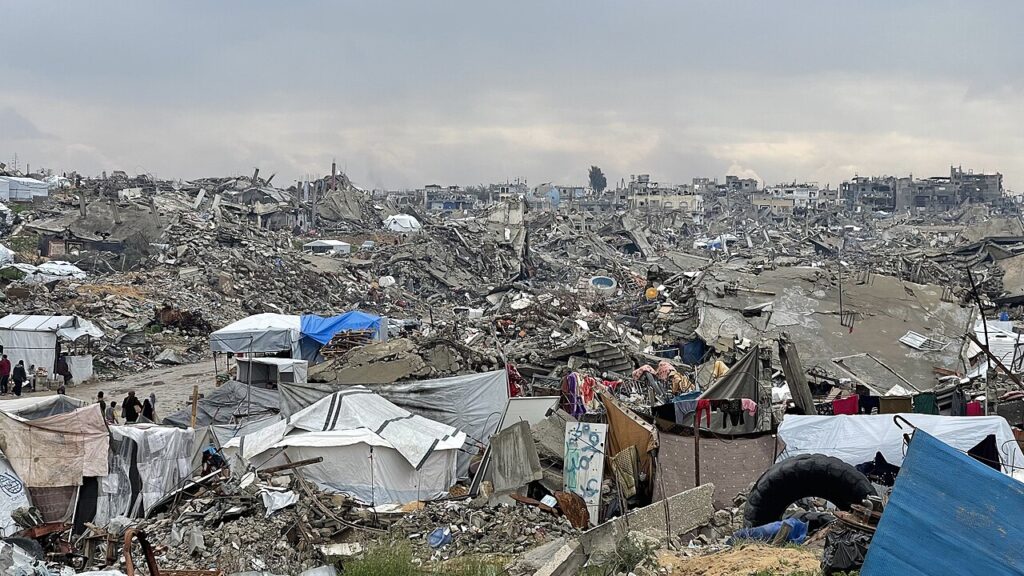
The Gaza crisis fits into this picture as one of the principal multipliers of regional instability, acting as a hinge between the local dynamics of the Israeli-Palestinian conflict and the broader strategic competitions shaping the Middle East. The so-called “phase two” of the ceasefire has appeared structurally fragile from the outset, as the reduction in hostilities has not translated into genuine political stabilization or a shared redefinition of security arrangements. On the ground, the Gaza Strip remains marked by widespread destruction, massive internal displacement, and structural dependence on humanitarian aid, while effective control over security and governance remains unresolved and heavily conditioned by Israeli decisions. The options advanced so far – from gradual demilitarization to the establishment of a technocratic, transitional Palestinian governance and even international monitoring mechanisms – run up against deep and unresolved political constraints. Israel subordinates any progress to stringent and renewable security guarantees, consistent with a logic of preventive deterrence and risk management; at the same time, Hamas is unlikely to accept a reduction of its role in the absence of credible political trade-offs extending beyond mere administrative survival. As a result, the security dimension tends to prevail over the political one, entrenching an emergency-driven approach that freezes the conflict without addressing its structural causes. The increasingly evident risk is that a “technical” governance arrangement in Gaza could evolve into an administratively functional yet politically illegitimate solution, incapable of addressing the core issue of Palestinian representation and easily perceived as externally imposed. In the absence of a clear political horizon – one that includes substantial reform or strengthening of the Palestinian National Authority, as well as a minimum level of internal consensus – phase two risks crystallizing into an armed truce, highly vulnerable to renewed cycles of violence and readily exploitable by regional actors as a tool of indirect pressure, both against Israel and within the broader confrontation involving the United States, Iran, and their respective allies. In this sense, Gaza continues to represent not only a theater of humanitarian crisis but also a systemic source of instability, capable of reactivating latent regional tensions whenever broader equilibria come under strain.
At the same time, Syria remains a veritable laboratory of regional competition. Tensions between the central government and Kurdish forces in the north highlight the fragility of the Syrian state reconstruction process and the absence of an inclusive political settlement. Damascus’s efforts to reintegrate Kurdish-held territories by curtailing their military and political autonomy intersect directly with Turkey’s strategic priorities, as Ankara views Kurdish forces as a direct threat to its national security. As a result, the Kurdish dossier has ceased to be a purely domestic issue and has instead become a key arena of indirect competition among regional actors with divergent agendas. In this context, relations between Israel and Turkey have taken on an increasingly conflictual character. Ankara seeks to consolidate its influence in northern Syria and to prevent any form of Kurdish consolidation; Israel, by contrast, looks with suspicion on an expanding Turkish role in the Levant and favors a structurally weak or fragmented Syria, deemed less capable of hosting coordinated threats against its territory. This logic is also reflected in Israeli actions in Syria and Lebanon, which go beyond the mere containment of the pro-Iranian axis and are embedded in a broader strategy of managing regional power balances, with a clear anti-Turkish dimension as well. The two fronts are increasingly interconnected: striking Hezbollah in Lebanon serves not only to limit Iran’s strategic depth but also to hinder stabilization processes that could facilitate an expansion of Turkish political and military influence. The result is a multi-layered strategic friction, in which each actor’s advances are perceived by others as relative losses, fueling indirect competition and chronic instability in the absence of effective de-escalation mechanisms.

Completing the regional picture are intra-Gulf tensions, particularly between Saudi Arabia and the United Arab Emirates. What once appeared to be a solid and complementary partnership has progressively evolved into a structural competition for regional leadership, driven not only by divergent visions of Yemen’s future and power projection in the Red Sea and the Horn of Africa, but also by competing conceptions of influence, alliance networks, and global roles. Disagreements over local partnerships, control of port infrastructure, access to key trade routes, and models of geo-economic influence have steadily eroded Gulf cohesion at a time when greater coordination is required to address systemic challenges such as the Iranian threat or maritime security. This competition has facilitated the emergence of increasingly defined regional blocs, with the potential to profoundly reshape the architecture of Middle Eastern alliances. While it does not necessarily translate into open conflict, it acts as a factor of systemic fragmentation, weakening regional mediation capacities and complicating the management of peripheral yet strategically vital theaters such as Yemen, the Red Sea, and the Horn of Africa. At the same time, it heightens overall unpredictability, rendering regional balances more volatile and alliance patterns more opaque for external actors, including the European Union.
Overall, the picture that emerges is of a region in which crises can no longer be analyzed in isolation. The Iranian nuclear negotiations, the fragile truce in Gaza, Syria’s incomplete reconstruction, and intra-Gulf rivalries are all components of a single, unstable regional system, characterized by precarious equilibria, increasingly strained deterrence, and unresolved political processes. In the absence of structural and inclusive solutions, risk management and escalation containment remain, in the short term, the most realistic objectives for regional and international actors, in a context where stability appears increasingly as a temporary outcome rather than a durable equilibrium.
Giuseppe Dentice