As Israel prepares for the parliamentary election scheduled for 27 October 2026, its political landscape remains deeply fragmented, shaped by ideological divisions, competing visions of national security, and disagreements over the country’s political and institutional future. The electoral contest is unfolding against the backdrop of the Israeli-Palestinian conflict, the consequences of the war in Gaza, tensions over the relationship between religion and state, and the continuing debate surrounding Benjamin Netanyahu’s leadership.
The competition is broadly structured around two political camps: parties supporting Netanyahu and those seeking to replace him. However, this distinction does not fully capture the complexity of Israel’s party system, where political affiliations often transcend the traditional left–right divide and where nationalist, religious, secular, centrist and Arab political forces pursue different priorities.
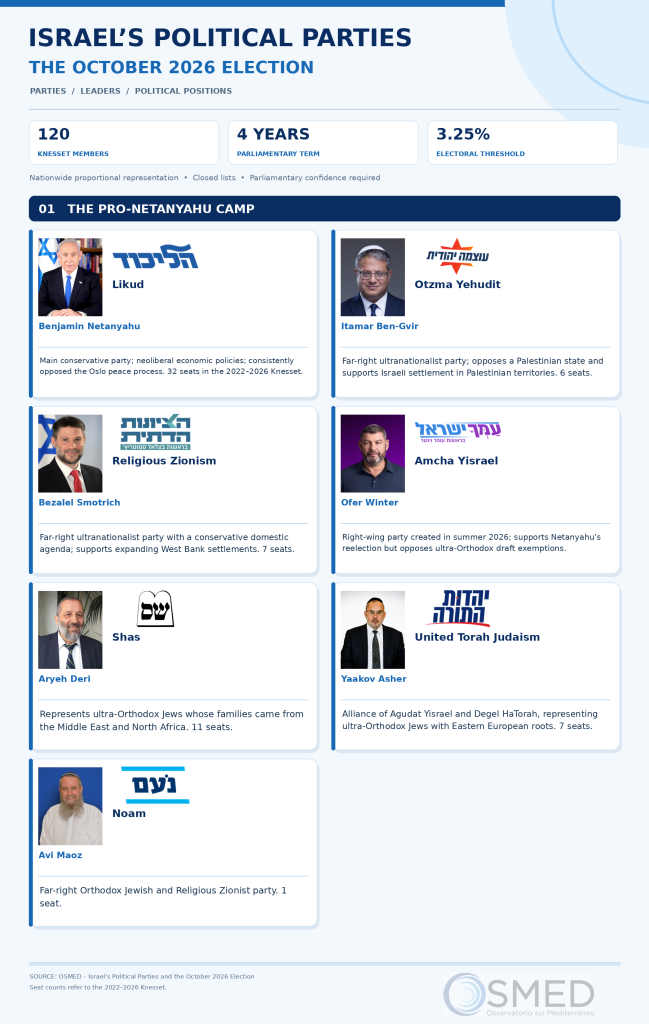
The pro-Netanyahu camp is centred on Likud, led by the incumbent Prime Minister, and includes far-right and religious parties such as Otzma Yehudit, Religious Zionism and its electoral allies, Shas and United Torah Judaism. Smaller political forces, including Noam and Ofer Winter’s Amcha Yisrael, also form part of the broader right-wing political landscape, although their electoral prospects and political weight differ considerably. Despite shared support for Netanyahu, tensions persist within this political area, particularly over military conscription, exemptions for ultra-Orthodox communities, and the relationship between religious authority and state institutions.
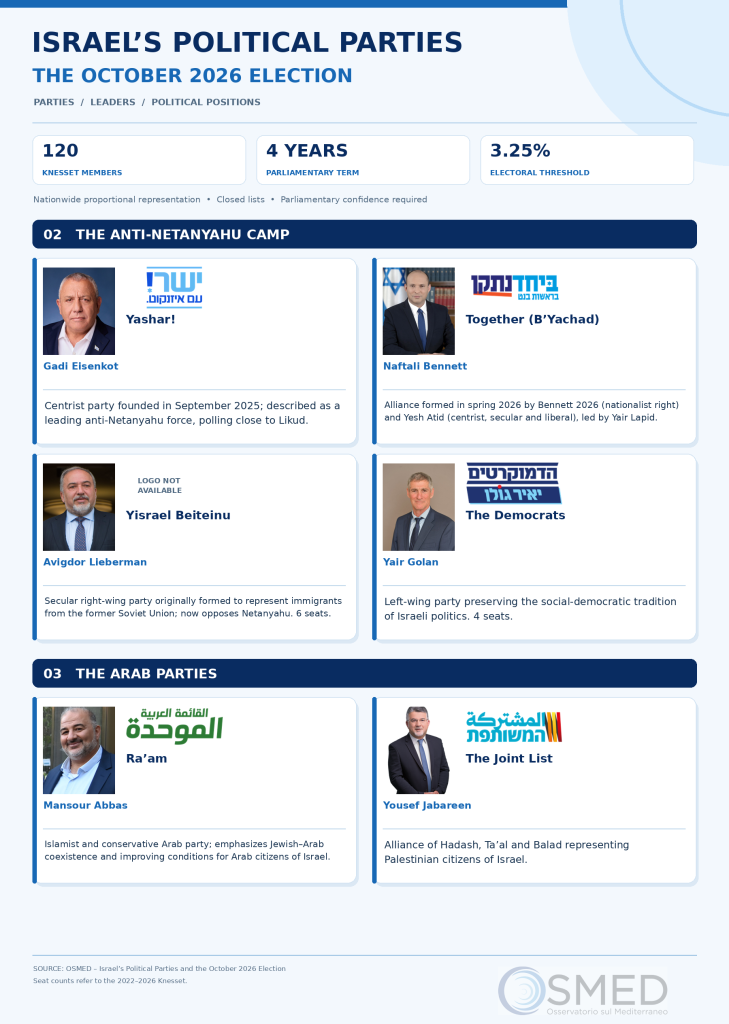
The anti-Netanyahu camp is considerably more heterogeneous, encompassing centrist, secular right-wing and centre-left forces. Gadi Eisenkot’s Yashar, the Together alliance led by Naftali Bennett and joined by Yair Lapid, Avigdor Lieberman’s Yisrael Beiteinu and Yair Golan’s The Democrats represent distinct political traditions and priorities. Recent opinion polls have identified Eisenkot and his party as leading challengers to Netanyahu. Nevertheless, opposition to the incumbent Prime Minister does not automatically translate into a shared political programme, and the formation of a viable alternative governing coalition remains a significant challenge.
Arab political parties constitute another important component of Israel’s electoral landscape. Ra’am, led by Mansour Abbas, and the Joint List, bringing together Hadash, Ta’al and Balad, reflect different approaches to political representation, the rights of Palestinian citizens of Israel, and relations with the country’s Jewish majority. Their electoral performance could prove decisive in determining the parliamentary balance of power, although the reluctance of major Jewish opposition parties to establish formal governing coalitions with Arab parties remains a significant obstacle.
Israel’s electoral system adds another layer of complexity. The 120 members of the Knesset are elected through a closed-list proportional representation system in a single nationwide constituency, with an electoral threshold of 3.25%. Since a government must secure parliamentary confidence, the ability to assemble a majority of at least 61 seats is central to the political process. Coalition negotiations are therefore often as consequential as the election results themselves.
The latest pre-election polls suggest a highly competitive contest, with neither of the two main political camps assured of obtaining a parliamentary majority. Beyond the electoral performance of individual parties, the outcome will depend on the distribution of seats among smaller political forces, the willingness of different parties to cooperate, and the prospects for overcoming the divisions that have long characterised Israeli politics.
Against this background, the Observatory on the Mediterranean (OSMED) presents two complementary infographics mapping Israel’s main political parties, their leaders and their political orientations. The first focuses on the pro-Netanyahu camp, while the second examines the anti-Netanyahu forces and Arab parties.
Together, these visual guides offer an overview of the principal actors shaping Israel’s electoral competition and the political alignments that could determine the composition of the next Knesset and the formation of a new government.